

The European Accessibility Act, a year and a half in
Since June 2025, online shops, banks, transport and telecoms services in the EU have had to work for disabled customers. Here's who is covered, what that means in practice, and what enforcement has looked like so far.
· By Tural Jumshud · 8 min read
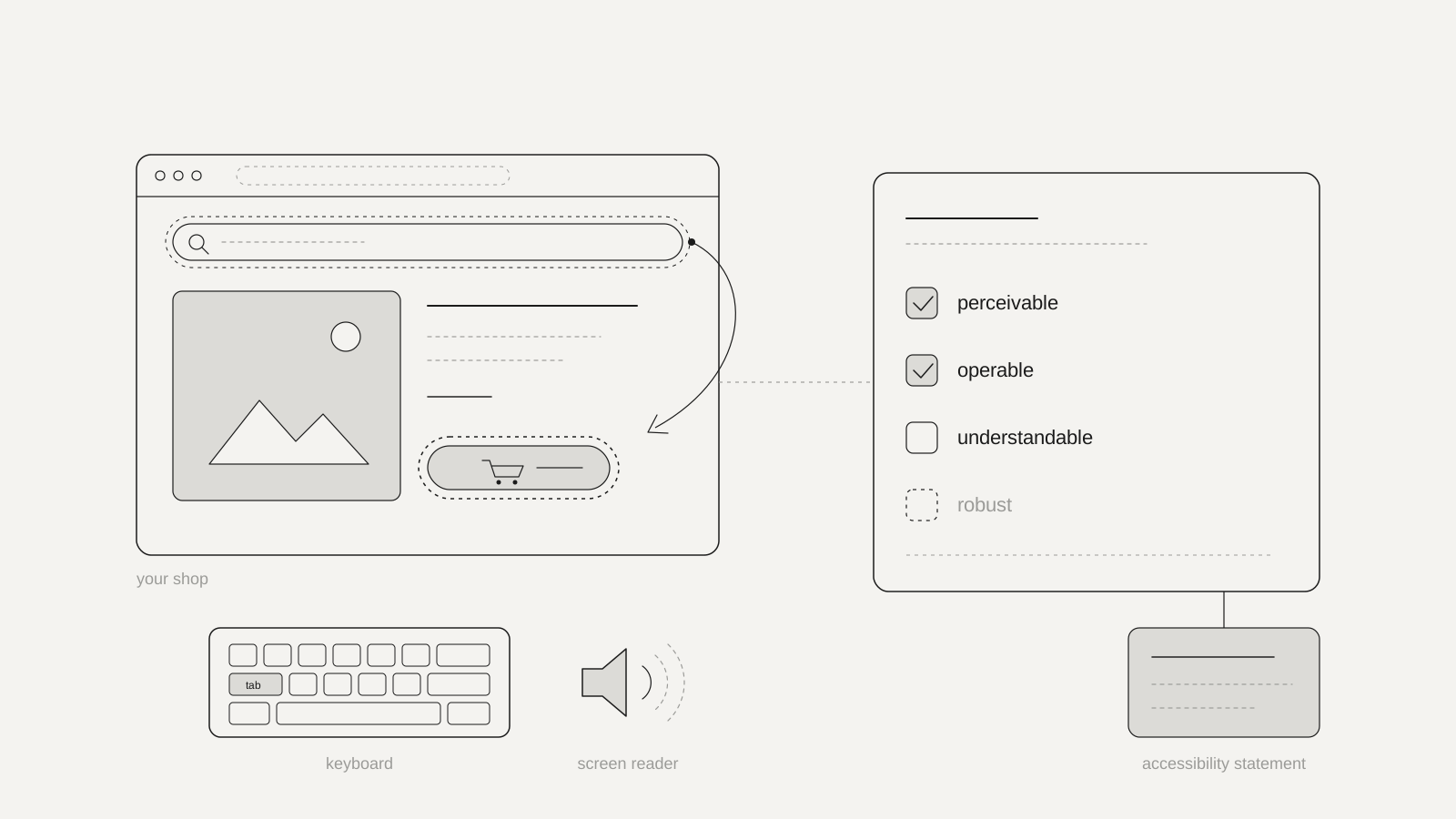
The European Accessibility Act applies to your website or app if you sell to consumers online in the EU, or offer banking, passenger transport, e-book or telecoms services, and you aren't a microenterprise. Since 28 June 2025, those services must be usable by disabled people, which in practice means meeting WCAG 2.1 level AA.
Seventeen months in, the rules are no longer theoretical. A French court has ordered a major retailer to fix its site and app, the Dutch regulator has tested the country's biggest webshops, and complaint routes are open across Europe, including here in Poland. This post covers who is in scope, what "accessible" means in plain words, what enforcement has looked like so far, and what to do in your first hour.
This isn't legal advice. It's how we, as a design studio that builds websites and apps, read the rules and the cases so far.
Who does the European Accessibility Act cover?
It covers a defined list of services offered to consumers, plus some products. If your business isn't on the list, the Act itself doesn't apply to you, although other national rules might.
The services in scope (Article 2 of the directive) are:
- E-commerce: selling to consumers at a distance through a website or app. This is the one that catches most businesses.
- Consumer banking: payment accounts, credit, payments and e-money.
- Passenger transport: websites, apps and e-tickets for air, bus, rail and waterborne travel.
- E-books and the software used to read them.
- Electronic communications and services that give access to audiovisual media, such as TV guides and streaming menus.
The microenterprise exemption. A business with fewer than 10 people and an annual turnover or balance sheet total of no more than €2 million doesn't have to meet the requirements for services. If you have 10 or more people, or both your turnover and balance sheet are above €2 million, it doesn't apply to you. The exemption covers services only, not products like e-readers or payment terminals.
What's usually outside it. The e-commerce definition is about concluding a contract with a consumer. A portfolio site, a B2B-only shop or a site where nobody can buy anything is usually outside the Act. The directive also excludes some content: video and office documents (such as PDFs) published before 28 June 2025, archived pages not updated since then, online maps, and third-party content you neither pay for nor control.
One thing the transition rules don't do is give old websites a pass. The extra time in Article 32 is for existing service contracts (up to five years from June 2025) and for products already in use, such as ticket machines. A shop that was live before the deadline still has to be accessible now.
What does "accessible" mean in practice?
The directive says websites and apps must be "perceivable, operable, understandable and robust". Those are the four principles of WCAG, the Web Content Accessibility Guidelines, and the European standard most businesses measure against, EN 301 549, builds on WCAG 2.1 level AA.
In plain words, level AA asks things like these:
- Everything works with a keyboard. Someone who can't use a mouse can reach every link, menu, filter and button, in a sensible order, and can see where they are.
- Images and icons have text alternatives, so a screen reader (software that reads the page aloud) can describe them.
- Text has enough contrast against its background, and the page still works when zoomed in.
- Forms have labels and clear errors. "Postcode is missing" beats a red outline with no words.
- Video has captions, and nothing moving or timed traps people who need longer.
- The code says what things are, so assistive technology knows a button is a button and a heading is a heading.
For online shops, the directive adds two specifics: accessible information about the products you sell, and accessible identification, security and payment steps. The checkout counts as much as the homepage.
You also have to explain how your service meets the requirements, in your terms and conditions or a similar document. Most businesses do this with an accessibility statement linked from the footer.
A note on versions: in September 2026 the standards bodies published EN 301 549 V4.1.1, which moves from WCAG 2.1 to WCAG 2.2. It gains its full legal weight once it's cited in the EU's Official Journal. If you're building or rebuilding now, aim for WCAG 2.2 AA, which includes everything in 2.1.
What has enforcement looked like so far?
Penalties are set by each country, and the directive only says they must be "effective, proportionate and dissuasive". So far the pressure has come from courts, regulator tests and deadlines. In the cases we looked at, we didn't find a published EAA fine yet.
- France, a court order. On 4 June 2026, the court in Caen ordered Carrefour to make carrefour.fr and its mobile app fully accessible within six months, with a daily penalty for any delay after that. The case was brought by two disability associations, apiDV and Droit Pluriel. Carrefour argued it already met 71% of the French accessibility criteria; the court said that wasn't enough, and the site had to be fully accessible.
- France, a ruling the other way. A month earlier, on 5 May, the court in Lille dismissed a similar case against Auchan's e-commerce company. It applied an older French law with a €250 million turnover threshold, rather than the €2 million line from the EAA. The associations appealed. National rules can differ in surprising ways, and that's part of why we keep saying "check your country".
- The Netherlands, a regulator test. In March 2026, the ACM tested about 100 sites: the largest Dutch webshops and the biggest telecom and energy providers. At 61% of the largest webshops, it was impossible to place an order using assistive technology, and a third of the sites had serious problems. By June, it had visited ten large webshops with the biggest problems and planned a new test three months later, with a fine possible for any still failing.
- Sweden, supervision by sample. In October 2025, PTS began checking large Swedish online retailers, looking at three things: the homepage, a product page and the search function.
The pattern is useful. Regulators test the path a customer takes to buy something, and courts aren't impressed by a percentage score. A site is either usable for a disabled customer or it isn't.
How do complaints work in Poland?
Poland's version of the Act has applied since 28 June 2025, and it gives customers a clear route. We're based in Kraków, so here's how it works locally.
- A customer complains to the business, saying what doesn't work.
- The business has 30 days to answer, or up to 60 in complicated cases, as long as it explains why.
- If it doesn't answer in time, the complaint is treated as accepted.
- An accepted fix must be made within six months at most.
- The customer can also notify PFRON (the State Fund for Rehabilitation of Disabled Persons), which can inspect, order changes, temporarily ban a service and impose fines. For retail banking, the supervisor is the Financial Ombudsman (Rzecznik Finansowy).
The practical lesson: have a working contact for accessibility complaints, and treat the 30 days as a real deadline.
Where should you start?
You can learn a lot in an hour without any special tools. This is a first pass anyone can run before a proper audit.
Decide whether you're in scope
Write down which of the services above you offer, to whom, and whether you're over the microenterprise line. If you sell into several EU countries, note which ones.
Buy something without a mouse
Use only the Tab, Enter and arrow keys. Search, open a product, add it to the basket, check out and reach the payment step. If you get stuck or lose track of where you are, so will your customers.
Listen to your checkout
Turn on the free screen reader on your device: VoiceOver on a Mac or iPhone, TalkBack on Android, NVDA on Windows. Listen to a product page and your checkout form. Do the buttons and fields make sense read aloud?
Zoom and squint
Zoom the browser to 200% and then 400%. Nothing should overlap or disappear. Check grey-on-white text and text on photos with a free contrast checker.
Run an automated check
Tools like WAVE, axe or Chrome's Lighthouse find missing labels, alt text and contrast problems quickly. They catch only part of the picture, which is why the first three steps come first.
List what you don't control
Cookie banners, chat widgets, payment forms and CAPTCHAs are often where the path breaks. Ask each supplier how they meet WCAG.
Publish your statement and contact
Say what you've checked, what you know isn't right yet and when you'll fix it, and how people can report a problem.
Can an accessibility widget do this for you?
No. Overlay toolbars that let visitors change fonts or contrast don't change the code underneath, so a button without a label still has no label. The Caen ruling and the Dutch tests both looked at whether a disabled customer could actually buy something. A widget doesn't change that answer.
What works is building it in: designing with enough contrast and clear focus states, writing proper labels, and testing with a keyboard and a screen reader as you go. Fixing it afterwards is possible, but it costs more, especially in checkout flows built from third-party parts.
How we approach it
On our projects, accessibility is part of the design system rather than a final check: colours chosen for contrast, focus states designed alongside hover states, components built with proper roles and labels. On this site, for example, there's a "skip to content" link for keyboard users, and the animations respect the reduced-motion setting on your device. It's part of what we mean by an enterprise-grade website.
There's a side benefit too. The headings, labels and structure that a screen reader relies on are the same signals search engines and AI assistants read, which we covered in AEO, GEO and your website in AI search. An accessible site is usually an easier site for every kind of reader.
FAQs
Are small businesses exempt from the European Accessibility Act?
Microenterprises that provide services are exempt: fewer than 10 people and an annual turnover or balance sheet total of no more than €2 million. The exemption covers services such as an online shop, not products like e-readers or payment terminals.
Does the European Accessibility Act apply to a B2B website?
The Act covers services provided to consumers. A website that only sells to businesses, or a brochure site where nobody can buy anything, is usually outside its e-commerce rules. National laws can go further, so check the law in each country you sell to.
Should I aim for WCAG 2.1 or WCAG 2.2?
The European standard most businesses test against, EN 301 549 v3.2.1, is based on WCAG 2.1 level AA. Its successor, V4.1.1, published in September 2026, moves to WCAG 2.2. Aiming for WCAG 2.2 AA covers both.
Does an accessibility overlay or widget make my site compliant?
No. A toolbar that changes fonts or contrast doesn't fix missing labels, broken keyboard paths or an inaccessible checkout. Regulators and courts look at whether a disabled customer can actually complete a purchase.
What happens if a customer complains about accessibility in Poland?
The business has 30 days to answer, or up to 60 in complicated cases. If it doesn't answer in time, the complaint is treated as accepted, and an accepted fix must be made within six months. The customer can also notify PFRON, which can inspect and fine.
Sources
- Directive (EU) 2019/882 (European Accessibility Act), Articles 2-4, 30-32 and Annex I, via EUR-Lex; text read via legislation.gov.uk archive
- European Commission, Web Accessibility Directive: standards and harmonisation (EN 301 549 v3.2.1 and WCAG 2.1), via Shaping Europe's digital future
- Davis Wright Tremaine, EN 301 549 V4.1.1 and the European Accessibility Act, September 2026, via DWT
- ACM (Netherlands Authority for Consumers and Markets), study of large webshops, 24 March 2026, via ACM
- NOS, Webshops beter toegankelijk voor slechtzienden, maar nog veel werk nodig, 22 June 2026, via NOS
- Tribunal judiciaire de Caen, order against Carrefour, 4 June 2026, reported by Handicap.fr and Deque, June 2026
- Tribunal judiciaire de Lille, Auchan E-Commerce ruling, 5 May 2026, via Silktide
- PTS (Swedish Post and Telecom Authority) opens e-commerce accessibility supervision, 16 October 2025, via M3
- Podatki.biz, Polish accessibility act and financial services (Financial Ombudsman supervision of retail banking), via Podatki.biz
- PFRON, Kompas Dostępności no. 5 (complaints under the Polish accessibility act), May 2026, via PFRON
Work with zunidesign

Let's talk about your project.
If your shop, booking flow or app needs to work for every customer, we design and build accessibility in from the first screen, and we can look at where your current site stands. Let's talk.
 Book a meeting