

When the designer also writes the code
A design engineer removes the handoff between design and code, which is where a lot of quality gets lost. It also puts a lot on one person. Here's how to tell which setup your product needs.
· By Tural Jumshud · 8 min read
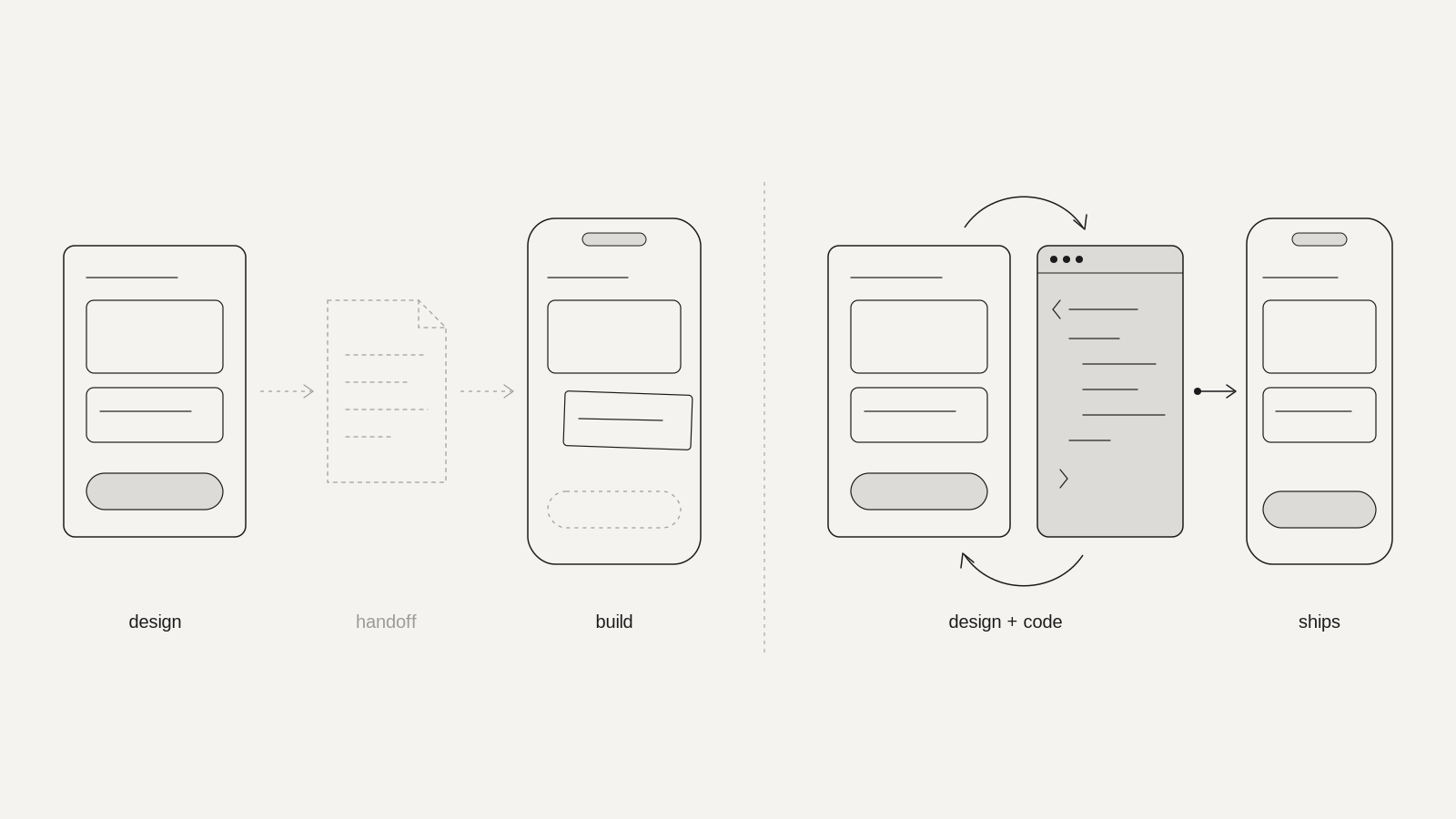
Hire a design engineer, one person who designs your product and writes its front-end code, when the product is early, lives or dies on how it feels, and speed matters more than headcount. Hire a separate designer and developer when the hard parts are on the server, the work needs several people in parallel, or you need deep specialists.
Most articles on this question compare job descriptions. That isn't the useful part. The useful part is knowing what gets lost between two people, what one person can't carry alone, and which of those risks your product can live with.
We're a studio where the person who designs also writes the code, so we have an obvious bias. We'll try to be fair about where that model stops working, because knowing that is part of doing it well.
What is a design engineer?
A design engineer designs the interface and builds it, usually the front end: the screens, interactions, animations and states that people actually touch. Vercel, which has a whole team of them, says design engineers "blend aesthetic sensibility with technical skills", so they can understand a problem, then design, build and ship a solution themselves.
It's worth being clear about what the title doesn't mean. A design engineer isn't a full-stack developer who also picks the colours. Even at Vercel, when design engineers are embedded in product teams, they build the interface while the product team builds the API and infrastructure behind it. The role covers the part between the design file and the user, not the whole system.
You'll also see "UX engineer", "creative developer" and "designer who codes". The labels vary; the test is the same. Can they show you live work where they made the design decisions and wrote the code that shipped?
What gets lost in a handoff?
Mostly the details nobody wrote down. In a classic handoff, a designer finishes the screens and passes them to a developer, who has to interpret anything the file doesn't say. Dan Mall, who with Brad Frost proposed passing work back and forth constantly instead, put the problem simply: "Designers hand off comps to developers and think their work is done."
What we see go missing most often:
- States nobody drew. The empty list, the slow connection, the error, the very long name. The developer invents them under deadline.
- Motion and timing. A transition that made the prototype feel calm gets cut because it was hard to describe in a ticket.
- Small drift. Spacing, type sizes and alignment shift a little on every screen, until the product no longer looks like the design anyone approved.
- Feasibility surprises. A design that can't be built as drawn gets quietly simplified, without the designer in the room.
Nobody is happy with this. Figma's research found that 91% of developers and 92% of designers believe the handoff process could be improved. Good teams close the gap with shared design systems, early reviews and pairing. A design engineer closes it by not having one.
What do you gain when one person designs and builds?
Fewer conversations, decisions made in the real medium, and a live product that matches what you approved. The gains are mostly about time and fidelity.
- Less coordination. Fred Brooks pointed out in 1975 that the number of communication lines in a team grows faster than the team: n(n−1)/2. A founder, a designer, a front-end developer and a backend developer make four people and six lines to keep in sync. Replace the designer and front-end developer with one design engineer, and it's three people and three lines.
- Decisions made in the browser or on the phone. Things like scrolling, gestures, loading and animation are judged by feel. Designing them directly in code means you approve the real thing, not a picture of it.
- Feasibility checked as you go. The person designing knows what each idea costs to build, so expensive ideas get questioned early, and cheap wins don't get missed.
- Faster changes. When feedback arrives, there's no new spec, ticket and review round. The person who heard it makes the change.
An example from our own work: on Final Table, testing the gesture pad with more than 100 poker players showed that some bet sizes were used constantly and others rarely, so we re-weighted the slider's snap zones towards the common ones. That kind of change is hard to write as a spec and easy to get wrong in translation. It's tuned by hand, on a phone, until it feels right.
Where does one person stop being enough?
When depth, volume or risk outgrow a single head. A design engineer is a strong fit for a lot of products, and a poor fit for some. Be wary of anyone who says otherwise.
- Backend depth. Payments, sensitive personal data, complex integrations, real-time systems and heavy traffic need someone who does server work every day. Most design engineers can wire up simple services; they shouldn't be the last line of defence for your customers' data.
- Volume. One person does one thing at a time. If you need a large product in a fixed number of months, you need people working in parallel.
- Specialist platforms. Heavy native work, hardware, game engines or machine learning often need specialists the design engineer works alongside.
- A second pair of eyes. When the same person designs and builds, nobody naturally questions their choices. Testing with real users and code review from someone else make up for that.
- The single point of failure. If one person holds all the knowledge, illness or a new job stops the product. This is solved by handover, not by headcount, but it has to be planned.
The common answer in practice is a mix: a design engineer owns everything people see and touch, and a backend developer owns data, security and infrastructure. That's two specialists with one clean boundary between them, instead of three people with two fuzzy ones.
Has AI changed the answer?
It has blurred the roles, but it hasn't removed the need for someone who owns both the design and the code. Figma's 2026 AI report found that, in a year, the share of designers taking part in development doubled from 21% to 41%, while developers doing design work rose from 44% to 60%. In Figma's 2025 roles research, 64% of the 1,199 people surveyed identified with two or more roles.
The Designer Fund and Foundation Capital AI in Design report, a survey of more than 900 designers reported by Fast Company in May 2026, found that half of designers had shipped AI-generated code to production. That's not the same as being a design engineer. Shipping code is easy now; understanding it well enough to keep it secure, fast and maintainable is the part that still takes skill. We wrote about the risks in security checks for your vibe coded app.
What AI has changed is the cost of building early. A design engineer with good tools can get a working version in front of users far sooner than before, which makes the "one person, real thing early" approach stronger for prototypes and first versions.
Which setup fits your product?
Look at where your product's hardest problems sit. These four questions usually settle it.
Is the hard part what people see, or what happens behind it?
If success depends on the interface being clear, quick and pleasant (a consumer app, a SaaS dashboard, a marketing site, an AI feature people need to trust), a design engineer is a strong choice. If it depends on data, money or integrations, start with backend expertise and add design.
How early are you?
For a prototype or MVP, one person who can design, build and change things daily is usually the fastest route to learning. Our guide to prototypes, MVPs and production apps explains what each stage needs.
How much has to happen at once?
If the roadmap needs several features built in parallel, you need several people. A design engineer can still set the design system and front-end patterns that everyone else builds on.
Who will run it afterwards?
If your own team will take over, check that the person you hire leaves behind things they can use: components named the same in the design file and the code, documentation and access to everything.
How do you check a designer who says they code?
Ask to see live work and talk through it. Portfolios show pictures; you want proof of decisions carried all the way to production.
- Ask for a live product or site, not only screenshots, and which parts they designed and coded themselves.
- Ask them to show you a state most people forget, such as an empty screen or an error, and explain how they decided it.
- Try it on your own phone with a slow connection, and with the keyboard only. Quality shows up in the uncomfortable cases.
- Ask what they would not build themselves on your project. A good answer names specific parts and who should do them.
- Ask where the code will live and what you'll receive at the end. The right answer is your own repository and a proper handover.
How does this work at zunidesign?
zunidesign is a design studio in Kraków that designs products and websites, then builds them. Tural Jumshud designs the product and writes the front-end code, so what you approve is what ships. This site and its voice and text assistant were designed and built the same way.
Where a project needs deep backend or specialist work, we say so early and work alongside your developers, and we hand everything over so your team isn't dependent on us. You can read more about how we approach product design.
FAQs
What is a design engineer?
A design engineer is someone who designs the interface and also writes the code for it, usually the front end: the screens, interactions and animations people touch. Vercel describes the role as blending aesthetic sensibility with technical skills, so one person can design, build and ship a solution.
Can a design engineer build the backend too?
Usually only the simple parts. Most design engineers are strongest on the front end. Anything involving payments, sensitive data, complex integrations or heavy traffic deserves a backend engineer, either on your team or alongside the design engineer.
Is one design engineer cheaper than a designer and a developer?
Not always per hour, but often in total. Fewer people means fewer meetings, fewer specs and less rework from misread designs. The real limit is capacity: one person can only do one thing at a time, so large scopes still need more people.
What happens if the one person who built it leaves?
That risk is real, so plan for it from the start. Insist that the code lives in your own repository, components are documented, the design library matches the code, and there's a recorded walkthrough, so another designer or developer can take over.
Do I still need a designer if my developer uses AI tools?
Usually yes. AI tools can produce screens and code quickly, but they don't decide what your product should do, test it with real people or notice when something feels wrong. Someone still has to own those decisions.
Sources
- Vercel, Design Engineering at Vercel: What we do and how we do it, March 2024, via Vercel
- Dan Mall, The Hot Potato Process (with Brad Frost), via danmall.com
- Figma, 79+ design statistics: tools, collaboration and AI (handoff figures from Figma research, 2025), via Figma
- Figma, Figma's 2026 AI report: Can AI help us collaborate better?, Madeline Stafford and Shane Johnston, 2026, via Figma
- Figma, Are roles and responsibilities a thing of the past? (2025 shifting roles report), Matt Walker, 2025, via Figma
- Grace Snelling, on the Designer Fund and Foundation Capital AI in Design report, May 2026, via Fast Company
- Fred Brooks, The Mythical Man-Month (1975), on communication overhead, via Wikipedia: Brooks's law
Work with zunidesign

Let's talk about your project.
Wondering whether one person can design and build your product, or where you'd need more hands? We design products and websites and write the front end ourselves, and we'll tell you plainly when part of your product needs a specialist. Let's talk.
 Book a meeting